Peel & Stick Wallpaper: Install It & Does It Damage Walls?
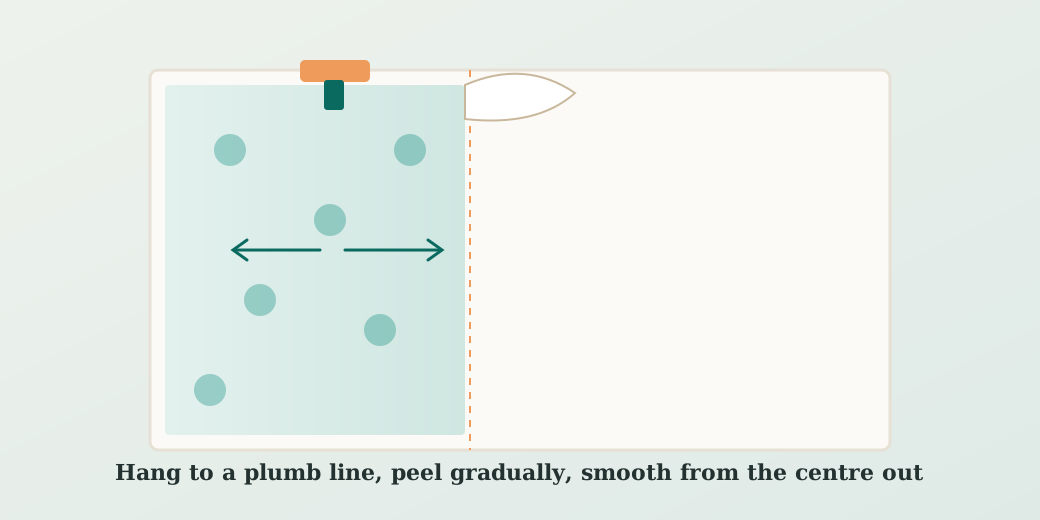
▲ Illustration — start against a plumb line, peel the backing a few feet at a time, and smooth from the centre outward.
Peel & stick wallpaper goes on a smooth, cured, satin/semi-gloss painted wall: snap a plumb line, peel the backing a few feet at a time, and smooth from the centre out. It's renter-friendly and removes cleanly from the right wall — but it can pull flat/matte paint, won't behave on textured or flaky walls, and needs fresh paint to cure first. Match it to the wall and it's a low-commitment makeover.
Guidance is compiled from manufacturer install instructions and a reputable home source, cited in Sources.
Does peel and stick wallpaper damage walls?
This is the question every renter asks, and the honest answer is it depends on the wall. On smooth drywall painted with a satin or semi-gloss finish and fully cured, it usually comes off cleanly. Damage happens in three situations:
- Flat or matte paint — "temporary wallpaper may pull off paint with a flat or matte finish when you take it off"; a paint with sheen holds far better.[2]
- Textured or flaky walls — removing it "could damage sections of the wall with loose plaster."[2]
- Fresh, uncured paint — apply before paint has cured and it can fail to stick and lift the paint later.[1]
How to install peel and stick wallpaper
Prep the wall
Use a smooth wall in good condition, primed and painted with a satin or semi-gloss finish; let fresh paint cure fully, then wipe the wall with a 1:1 isopropyl alcohol and water solution.[1]
Measure and snap a plumb line
Measure the wall for panel quantity, then use a level to mark a plumb vertical line to start against — this keeps the whole run straight.[1]
Peel the backing gradually
Peel back only about 3–4 feet of the backing at a time rather than removing it all at once.[1]
Smooth from the centre out
Smooth with a squeegee from the centre outward; it "can be repositioned as needed to ensure pattern alignment and to eliminate bubbling."[1]
Overlap seams, then trim
Continue in 3–4 ft increments, using a slight overlap at seams to avoid splitting, then trim with a craft knife. For a trapped bubble, prick it with a safety pin and press the air out.[1]
Will it stick to my wall?
It needs a smooth, flat, clean surface. The hard "no" is texture: "a bumpy texture will make it next to impossible to adhere the paper without air bubbles," and it lifts at the high and low points.[2] Heavily textured or flaky-plaster walls aren't a good fit. Glossy, cured, painted drywall is ideal; unpainted or freshly painted walls are not.
Removing it (and if it's peeling early)
To take it down, peel from a corner and pull back slowly at a low angle; warm stubborn areas with a hair dryer to soften the adhesive. On a suitable, well-painted wall it comes away cleanly. If a panel is lifting or curling on its own before you meant to remove it, that's a prep or surface issue — see our guide on why peel-and-stick wallpaper falls off.
Refacing a wall a different way?
For a kitchen or bath, peel-and-stick tile and contact paper are sturdier options — our guides cover both.
Affiliate disclosure: HowToApplyNow may earn a commission from qualifying purchases made through links on this page, at no additional cost to you. Products are added only after we vet the program and the terms — and only when a specific product's own instructions support their use for this task.
FAQ
Does peel and stick wallpaper damage walls?
On the right wall, no. On smooth drywall painted with a satin or semi-gloss finish and fully cured, it usually comes off cleanly. The damage happens on flat or matte paint (which it can pull off), on freshly painted walls that haven't cured, and on textured or flaky-plaster walls. Match it to the wall and it's renter-friendly.
How do you install peel and stick wallpaper without bubbles?
Start against a plumb line, peel only 3 to 4 feet of backing at a time, and smooth with a squeegee from the centre outward as you go. Reposition to align the pattern, overlap seams slightly, and if a bubble is trapped, prick it with a safety pin and press the air out.
Does peel and stick wallpaper work on textured walls?
Poorly. A bumpy texture makes it almost impossible to adhere the paper without air bubbles, and it can lift at the high and low points. It needs a smooth, flat, clean wall; heavily textured or flaky walls aren't a good fit.
Will it stick over fresh paint?
Not right away. Let freshly painted walls cure fully per the paint maker's instructions before applying, or the wallpaper can fail to stick and can pull the paint when removed. A satin or semi-gloss sheen holds far better than flat or matte.
How do you remove peel and stick wallpaper?
Peel from a corner and pull back slowly and steadily at a low angle; warm stubborn areas with a hair dryer to soften the adhesive. On a suitable, well-painted wall it comes away cleanly. If a panel is lifting or curling on its own, see our guide on peel-and-stick wallpaper falling off.
Sources
Research-first: a wallpaper manufacturer's install instructions for the method, and a reputable home-improvement source for the honest "does it damage walls / which surfaces" answer. Surface and paint conditions are stated as the sources state them.
- Tempaper — How to install peel and stick wallpaper — manufacturer (smooth, primed, satin/semi-gloss wall; cure fresh paint; wipe with 1:1 IPA/water; plumb line; peel 3–4 ft at a time; squeegee centre-out; reposition; slight seam overlap; safety-pin bubbles). tempaper.com
- Apartment Therapy — Does removable wallpaper damage walls? (flat/matte paint can pull off; textured/flaky walls problematic; texture causes bubbles; clean removal on smooth, sheen-painted walls). apartmenttherapy.com
Damage risk is framed as conditional (wall + paint dependent), as the sources describe it, rather than a blanket yes or no. Sources last reviewed: September 2026.