Can Window Film Crack Glass?
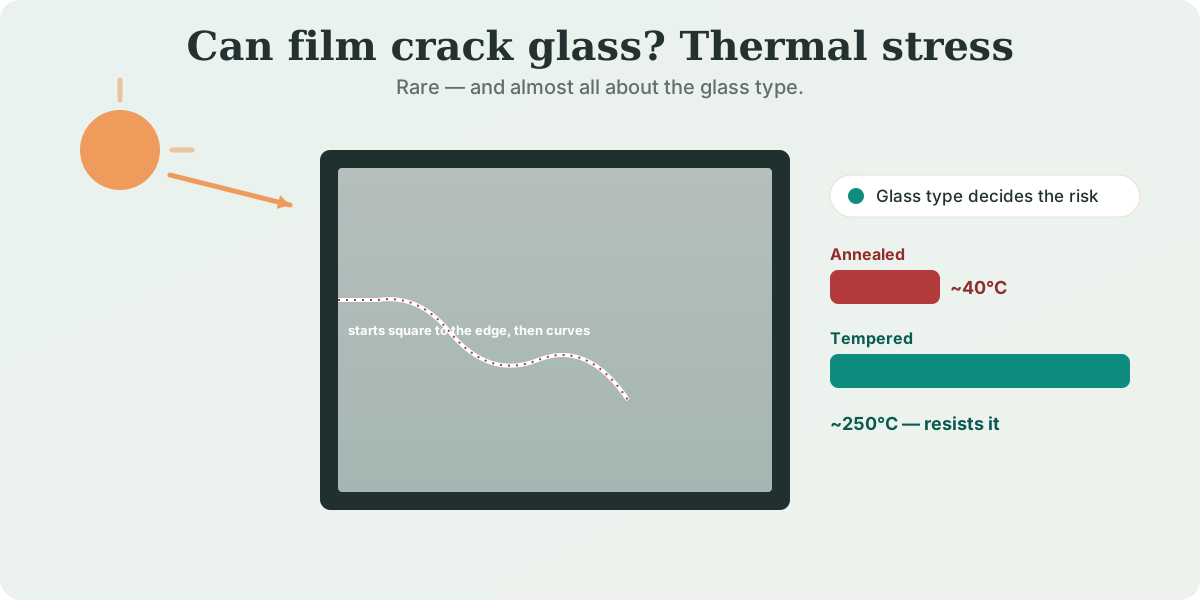
▲ Illustration — a thermal-stress crack starting square to the edge of a sun-warmed, film-darkened pane.
Rarely — but yes, it can, through thermal stress. A dark, heat-absorbing film makes the glass absorb more solar energy, and the temperature difference between the sun-warmed center and the cooler, shaded edge can crack the pane. The risk is almost all about the glass: annealed glass is vulnerable, while tempered glass is highly resistant. Match the film to your glass — and get a film-to-glass approval before putting a dark film on annealed glass — and it's very unlikely.
Guidance is compiled from manufacturer technical bulletins and industry sources, cited in Sources.
The short answer
Rarely — but yes, it can, through thermal stress. A dark, heat-absorbing film makes the glass soak up more solar energy; the sun-warmed center of the pane expands while the frame-shaded edge stays cooler, and if that temperature difference gets big enough, the glass can crack.[1] The risk depends almost entirely on your glass, not the glue: ordinary annealed glass is vulnerable, while tempered glass is highly resistant. Choosing a film matched to your glass — and getting a film-to-glass approval before putting a dark film on annealed glass — is what prevents it.
How thermal stress cracks glass
Glass is engineered to withstand roughly 3,000–5,000 psi of edge stress, and 3M notes that a damaged edge can lose up to half that strength.[1] A thermal-stress fracture is different from an impact break: it typically starts perpendicular to the edge and curves gently across the pane, with no point of impact.[6] The trigger is a temperature difference across the glass, and how much difference the glass can take is set by its type — see below.
What makes a crack more likely
3M lists the conditions that raise thermal-stress risk. Stack a few of these and the odds climb:
| Higher risk | Why |
|---|---|
| Dark, heat-absorbing (solar) film | Absorbs more energy → bigger temperature swing[1] |
| Annealed (non-tempered) glass | Tolerates only a small temperature difference[2] |
| Partial shading on the pane | Sun on part, shade on part = a steep gradient[1] |
| Tight blinds/curtains close to the glass | Traps heat against the film and glass[1] |
| HVAC vents blowing on the glass | Cools one area while the sun heats another[1] |
| Chipped or damaged edges | Weakens the glass exactly where stress concentrates[1] |
Which glass is actually at risk
This is the deciding factor. Annealed glass tolerates only about a 40 °C temperature difference before it can stress-fracture; heat-strengthened is roughly 1.5–2× stronger; and tempered tolerates around 250 °C, so it "will never be exposed to excess thermal stress in architectural applications."[2][4] That's why solar film on annealed glass triggers a formal film-to-glass approval, while any film is generally cleared on all-tempered units.[3] If you're not sure which you have, see how to tell what glass you have — and our tempered and double-pane guides.
How to avoid it
- Match the film to the glass. On annealed glass — especially annealed double-pane — get a film-to-glass approval from the film maker before choosing a dark/heat-rejecting film, or use a lighter film.[3]
- Keep edges healthy. Don't film glass with chipped or damaged edges.[1]
- Don't trap heat. Avoid tight interior blinds/curtains right against a filmed pane, and don't aim HVAC vents at the glass.[1]
Worried film could crack your glass?
Check your glass type, film type and goal — every result traces back to a manufacturer source.
Affiliate disclosure: HowToApplyNow may earn a commission from qualifying purchases made through links on this page, at no additional cost to you. Products are added only after we vet the program and the terms — and only when a specific product's own instructions support their use for this task.
FAQ
Can window film cause glass to crack?
It can, but rarely, through thermal stress: a dark, heat-absorbing film makes the glass absorb more solar energy, and the temperature difference between the warm center and cooler edge can fracture it. The risk depends mostly on the glass type — annealed glass is vulnerable, tempered glass is highly resistant.
What glass is safe from thermal-stress cracking?
Tempered glass is the safest — it tolerates roughly a 250°C temperature difference versus about 40°C for annealed glass, so any film is generally cleared on all-tempered units. Annealed glass is the vulnerable case, especially with a dark solar film, and should get a film-to-glass approval first.
How do I know if window film will crack my window?
Check the glass type first (tempered vs annealed), the film (dark, heat-absorbing films are higher risk), and the conditions (partial shading, tight blinds against the glass, HVAC vents on the pane, damaged edges). On annealed glass with a solar film, get a film-to-glass approval from the manufacturer.
Does window film crack double-pane windows?
Only if a heat-absorbing film is applied to annealed double-pane glass that can't handle the added edge stress. On tempered double-pane it's low risk. See our double-pane guide for the thermal-stress and warranty details.
Sources
Research-first: 3M's own thermal-stress bulletin and an industry film-to-glass thermal-stress document for the numbers and risk factors, plus a glass manufacturer for strength ratios; installer/industry pages are labeled where used. We separate the rare real risk (dark film on annealed glass) from the common myth that any film breaks any glass.
- 3M — Window Film Thermal Stress Technical Bulletin (edge stress ~3,000–5,000 psi; damaged edges lose up to 50%; risk factors: absorbing film, partial shade, tight coverings, HVAC on glass, painted/marked glass). 3m.com
- EWFA — Thermal Stress: Film-to-Glass Compatibility — industry (annealed ~40°C vs tempered ~250°C differential; tempered not exposed to excess thermal stress in architectural use). glassonweb.com / ngs.inc
- Solar Gard — Film-to-Glass Guide (any film on all-tempered; annealed needs a film-to-glass check/approval before solar film). solargard.com
- Guardian Glass — Technical reference — glass manufacturer (heat-strengthened ~1.5–2× and tempered ~3–4× the thermal-stress resistance of annealed). guardianglass.com
- ClimatePro — Window film & thermal stress — secondary (correctly-specified film on suitable glass rarely breaks it; risk is glass/type/condition dependent). climatepro.com
- Contra Vision — Thermal fracture of glass: risks — industry (a thermal-stress fracture starts perpendicular to the edge and curves; distinct from impact breakage). contravision.com
We don't claim film "won't" crack glass (an overclaim) nor that it commonly does (the scare version). The honest position — rare, glass-type dependent, preventable — is tied to primary thermal-stress data, and the annealed-vs-tempered figures are attributed to the industry source, not overstated. Sources last reviewed: August 2026.