How to Tell What Type of Glass You Have
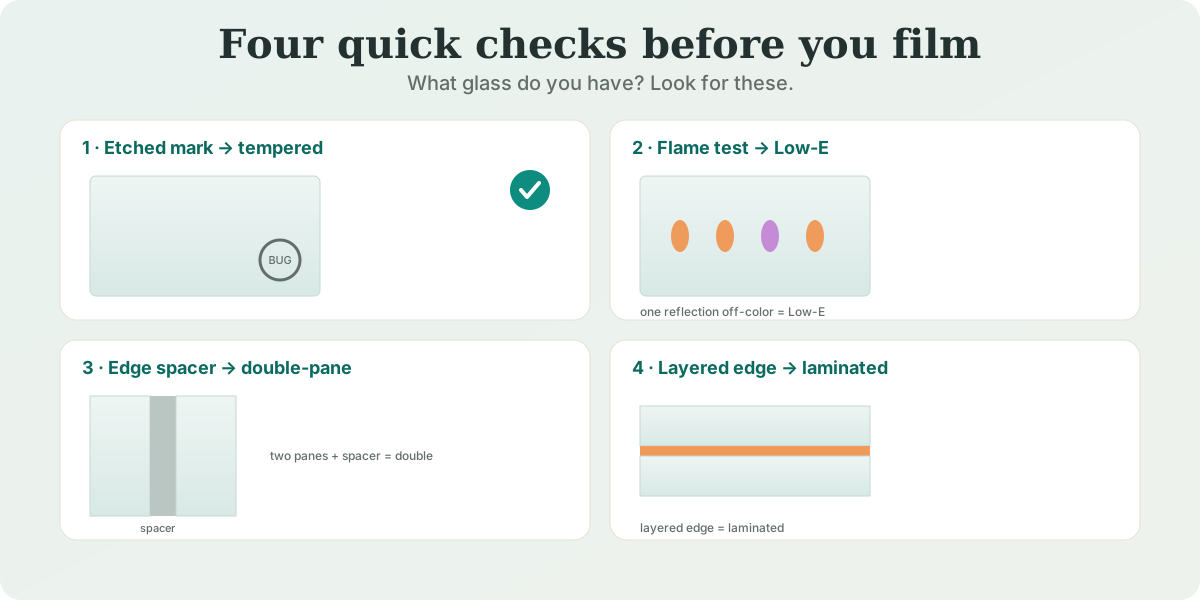
▲ Illustration — four quick checks: the etched tempering mark, the Low-E flame test, the edge spacer, and a laminated layered edge.
Before buying film, identify your glass — it decides what's safe. Tempered glass has a permanent etched mark in a corner (the one definitive test). A flame test reveals a Low-E coating — one reflection looks a different color. A visible spacer at the edge means double-pane. A layered sandwich edge means laminated. If you can't confirm it, treat the glass as unknown and check the manufacturer.
Guidance is compiled from safety-glazing standards and glass-manufacturer sources, cited in Sources.
Why it matters before you film
Your glass type decides what film is safe: whether it can crack from thermal stress, whether a coating is already there, and whether the warranty applies. A few minutes of identifying beats a cracked pane. Here's how to tell — and where each test is definitive versus just a clue.
Is it tempered (safety) glass?
The one definitive test: look for a permanent etched or sandblasted mark ("bug") in a corner. Safety-glazing rules require tempered glass to carry a mark that "cannot be removed without destroying it," showing the maker, the standard (ANSI Z97.1 and/or CPSC 16 CFR 1201) and the type.[1][3] If you find that mark, it's tempered — done. It's most likely in doors, glass next to doors, shower/tub enclosures, and large low panes, where code requires safety glazing.[4]
Clues only (not proof): through polarized sunglasses in daylight, tempered glass often shows faint dark spots or strain bands from the tempering process; reflections may show a rippled roller-wave distortion near the edges.[8][5] These indicate heat treatment but can be faint or absent — and the mark can be hidden by the frame, so "no mark found" means "unknown," not "annealed."[1]
Single or double pane?
Look at the edge of the glass where it meets the frame. A visible spacer bar (a metal or foam strip, often with a desiccant inside) between two panes means it's a sealed double-pane insulated unit; no spacer means single pane.[8] A quick confirmation: hold a small flame or flashlight near the glass and count the reflections — a single pane shows about 2, a double-pane shows about 4.[6]
Is it Low-E / coated glass?
Use the flame test (best after dark): hold a lit match or lighter a few inches from the glass and look at the row of reflected flames. Uncoated glass reflects them all the same orange. If one reflection is a noticeably different color — often pink, violet or blue — that surface carries a Low-E (or metallic) coating.[6] Counting which reflection is off-color tells you roughly which pane surface it's on.[7] Caveat: the flame test confirms that a coating exists and roughly where, but it can't tell a durable hard-coat from a film-sensitive soft-coat Low-E, or confirm the gas fill — so treat it as a strong clue, not the last word.
Is it laminated?
Laminated glass is two glass layers bonded to a plastic (PVB) interlayer. The definitive tell is a layered "sandwich" edge — but once the glass is framed, that edge is usually hidden, so this is often hard to confirm on installed windows; a duller "thud" when tapped is only a weak clue.[8] Laminated glass shows up in some entry doors, skylights and security/hurricane glazing.
No mark, not laminated? Treat it as unknown
Ordinary annealed (float) glass is the default when there's no tempering mark and no lamination — but remember the mark can simply be hidden. Never test by trying to break, drill or score the glass. If you can't confirm the type by inspection, treat it as unknown and check the window or film manufacturer's compatibility guidance before applying film — especially for a dark/solar film, where the annealed-vs-tempered question is exactly what decides the thermal-stress risk.
Which tests to trust
| Definitive (when visible) | Clue only |
|---|---|
| Etched tempering mark in a corner[1] | Polarized-lens strain pattern[8] |
| Layered edge = laminated[8] | Roller-wave distortion[5] |
| Visible spacer at edge = double-pane[8] | Flame test for Low-E / pane count[6] |
Know your glass — now check your film
Enter your glass type, film type and goal for a source-backed answer.
Affiliate disclosure: HowToApplyNow may earn a commission from qualifying purchases made through links on this page, at no additional cost to you. Products are added only after we vet the program and the terms — and only when a specific product's own instructions support their use for this task.
FAQ
How do I know if my glass is tempered?
Look for a permanent etched or sandblasted mark in a corner — safety-glazing standards require tempered glass to carry one showing the maker and standard, and it can't be removed without destroying it. It's most common in doors, near doors, shower enclosures and large low panes. If you can't find a mark, treat the glass as unknown, not automatically annealed.
How can I tell if I have Low-E glass?
Use the flame test after dark: hold a lit match or lighter near the glass and look at the reflected flames. If one reflection is a different color — often pink, violet or blue — that surface has a Low-E or metallic coating. It's a strong clue, but it can't tell a hard-coat from a film-sensitive soft-coat Low-E.
How do I tell single-pane from double-pane?
Look at the edge where the glass meets the frame for a spacer bar between two panes — that means a sealed double-pane unit. You can also count reflections from a small flame or flashlight: about 2 for single pane, about 4 for double.
What glass do I have if there's no mark?
Treat it as unknown, not confirmed annealed — the tempering mark can be hidden by the frame or worn off. Don't try to break or score the glass to test it. For a dark or solar film, confirm the type with the window or film manufacturer before applying, since annealed-vs-tempered decides the thermal-stress risk.
Does the type of glass affect window film compatibility?
Yes — it's the biggest factor. Textured/frosted glass won't hold film; annealed glass is the thermal-stress risk with dark films; tempered is the safest; Low-E and double-pane have their own rules. That's why identifying the glass comes first. Our compatibility checker maps glass + film + goal to a source-backed answer.
Sources
Research-first: safety-glazing standards (NGA, SGCC, CPSC) for the definitive tempered mark, and glass manufacturers (Guardian, Vitro) plus a federal lab (LBNL) for the coating and insulated-unit tests. Indicative tests (polarized, roller-wave, flame, tap) are labeled as clues, not proof.
- National Glass Association — FB11-06: Marking and Labeling of Architectural Glass (tempered safety glass must carry a permanent mark that cannot be removed without destroying it; can be obscured by the frame). glass.org
- SGCC — SD-203 Label Requirements — certification body (permanent label content: SGCC number, standard, thickness, class). sgcc.org
- CPSC — 16 CFR Part 1201 — Safety Standard for Architectural Glazing (federal basis; references ANSI Z97.1). ecfr.gov
- ASHI — Safety glazing — secondary (hazardous locations requiring safety glass: doors, sidelites, large low panes, shower/tub enclosures, near stairs). homeinspector.org
- Guardian Glass — Glossary: Roller Wave — glass manufacturer (heat-treatment distortion visible in reflections; a clue, doesn't distinguish tempered from heat-strengthened). guardianglass.com
- Vitro — Understanding Low-E Glass — glass manufacturer (flame/candle test: a single pane shows 2 reflections, double-pane 4; a Low-E coating shows one reflection a different color). vitrowindowglass.com
- Installix — Identifying Low-E on installed windows — secondary (counting which reflection is off-color infers the coated surface; can't confirm product/coating hardness/gas fill). installixwnd.ca
- LBNL / Fab Glass & Mirror — IGU spacers & tempered-ID methods — primary/secondary (visible spacer/desiccant confirms an insulated unit; polarized-lens strain-pattern test for tempered). lbl.gov / fabglassandmirror.com
Reliability is stated honestly: the etched mark, a visible laminated edge and a visible spacer are treated as definitive; polarized, roller-wave, flame and tap tests are labeled indicative-only. "No mark" is called out as "unknown," never as proof of annealed glass — and destructive break tests are excluded. Sources last reviewed: August 2026.