Does Insulating Window Film Actually Work?
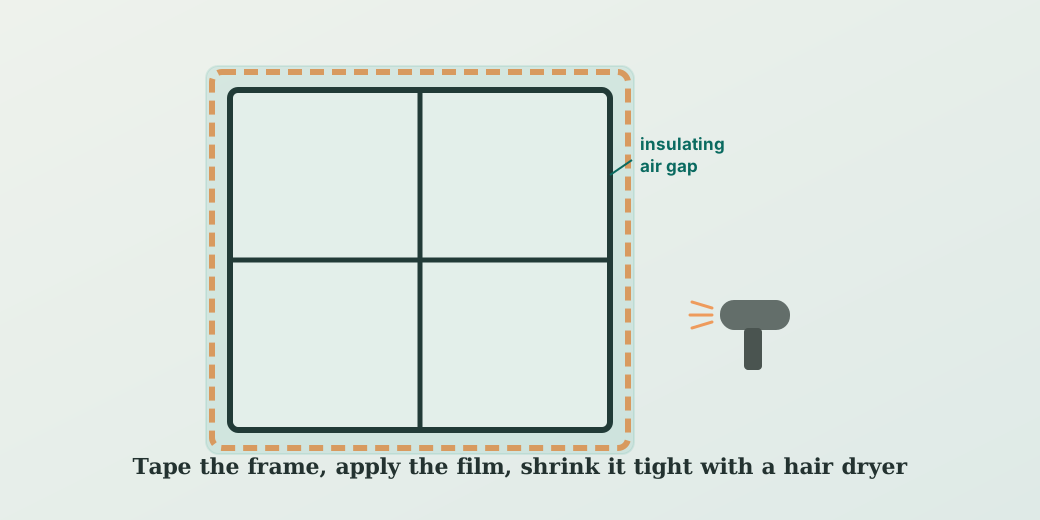
▲ Illustration — a shrink-film kit tapes over the frame and traps a layer of still air; a hair dryer shrinks it drum-tight.
Yes, but modestly. A winter shrink-film kit traps a layer of still air over the glass — it cuts drafts, feels warmer, and reduces condensation, but ENERGY STAR rates it only 2 of 5 stars for savings, with no miracle numbers. It's a cheap, seasonal comfort fix, best on draughty single-pane windows — not a replacement for proper glazing. Don't confuse it with permanent low-E film bonded to the glass, which is a different, year-round product.
Guidance is compiled from a government energy authority and manufacturer install guides, cited in Sources.
Does insulating window film actually work?
Honestly: it helps, but don't expect magic. The US energy authority ENERGY STAR rates the plastic-film project 2 out of 5 stars for energy savings, and describes the benefit in comfort terms, not big percentages: window film "reduce[s] drafts, help[s] the house feel warmer during winter months, and reduce[s] moisture buildup on the window due to condensation."[1] The mechanism is simple — the film "adds another layer of insulating air to reduce heat loss through the window."[1]
Two honest caveats from the same source: it's seasonal ("when winter is over, take down the plastic and pull the tape off the trim"), and it's a secondary measure — window projects "may have less impact on energy use than those in the attic and basement."[1]
Two kinds — don't confuse them
| Winter shrink-film kit | Low-E / energy-control film | |
|---|---|---|
| What it is | Clear plastic film taped over the frame | Film bonded permanently to the glass |
| How it helps | Traps an air layer; cuts winter draughts[1] | Cuts radiant heat loss/gain year-round[4] |
| Lifespan | Seasonal — remove in spring[1] | Permanent; higher cost |
| Best for | Renters, draughty single-pane, budget | Owners wanting year-round efficiency |
Most people searching for "window insulation film" mean the winter shrink kit — that's what the rest of this guide covers. If you want a permanent, year-round option, low-E retrofit film is a different product; independent research (rather than vendor claims) is the place to judge its payback.[4][5]
How to install a window insulation shrink kit
Clean the window frame
Wipe the frame to remove dust so the double-sided tape will hold.[2]
Apply the double-sided tape
Run the tape around the outside edge of the window frame, then peel off the tape liner.[2]
Measure and cut the film
Measure the window and add about 2 inches on each side to allow for shrinking, then cut the film to size.[2]
Attach the film
Start at the top, press the film firmly onto the tape, then work down the sides and bottom, keeping it flat.[2]
Will it work on my windows?
The gain is biggest on draughty single-pane windows, where the trapped air layer makes the clearest comfort difference. On double-pane units the improvement is smaller — the window already has an insulating gap (see window film on double-pane windows) — but a kit can still stop a felt draught around an older frame. It's ideal for renters because it's cheap and comes off at the end of winter.
Taking it down and reusing
Treat shrink kits as seasonal: ENERGY STAR's own instruction is to take the plastic down and pull the tape off the trim once winter's over.[1] The film usually stretches or tears coming off, so most people fit a fresh kit each year. For the tape residue and any adhesive left on the frame, the gentle methods in our film-removal guide apply — warm it and peel slowly.
Comparing film types for your window?
Enter your glass, film type and goal for a source-backed recommendation.
Affiliate disclosure: HowToApplyNow may earn a commission from qualifying purchases made through links on this page, at no additional cost to you. Products are added only after we vet the program and the terms — and only when a specific product's own instructions support their use for this task.
FAQ
Does insulating window film actually work?
Modestly. ENERGY STAR rates the plastic shrink-film project 2 out of 5 stars for energy savings — it reduces drafts, makes a room feel warmer in winter and cuts condensation, but there are no miracle savings numbers. It's a low-cost comfort upgrade and a seasonal supplement, not a replacement for proper glazing or attic and basement insulation.
What's the difference between a shrink-film kit and low-E window film?
A winter shrink-film kit is clear plastic film taped over the frame and shrunk tight with a hair dryer — cheap, seasonal, and easy to remove. Low-E (energy-control) film is a permanent film bonded to the glass to cut radiant heat loss and gain year-round; it's a different product at a higher price. Most searches for "window insulation film" mean the winter kit.
Is window insulation film reusable?
Treat shrink-film kits as seasonal and single-use: ENERGY STAR's guidance is to take the plastic down and pull the tape off the trim when winter is over. The film usually tears or stretches on removal, so most people fit a fresh kit each year.
Does insulating film work on single-pane or double-pane windows?
It helps most on draughty single-pane windows, where the trapped layer of air makes the biggest comfort difference. On double-pane windows the gain is smaller because the window already has an insulating gap, but a shrink kit can still cut a felt draught around an older frame.
Does window insulation film help with condensation?
Yes — ENERGY STAR notes it reduces moisture build-up on the window from condensation, because the film keeps humid indoor air off the cold glass. A tight, wrinkle-free seal is what makes the difference.
Sources
Research-first: a government energy authority for the honest efficacy framing, manufacturer guides for the install method, and independent research for the permanent low-E option. Energy benefits are stated qualitatively, as the authority states them — no invented savings percentages.
- ENERGY STAR (US DOE) — Applying plastic over windows (2-of-5-star savings; reduces drafts/condensation, feels warmer; adds an insulating air layer; seasonal; secondary to attic/basement). energystar.gov
- Duck Brand — How to install a standard window kit — manufacturer (clean frame; tape the edge; cut film +2" for shrink; press from the top; shrink with a hair dryer; trim; check the seal). duckbrand.com
- Frost King — Shrink window kits stop drafts — manufacturer (hair-dryer shrink method; draught reduction). frostking.com
- Family Handyman — Low-E window film benefits (permanent, year-round energy-control film — distinct from the winter kit). familyhandyman.com
- OSTI / US DOE — Low-emissivity energy-control retrofit window film — independent study (measured performance of permanent low-E retrofit film). osti.gov
No single manufacturer publishes a verified energy-savings percentage for shrink film, so savings are framed qualitatively and attributed to ENERGY STAR. The winter kit and permanent low-E film are kept clearly separate. Sources last reviewed: September 2026.