Blackout Window Film: Does It Block All the Light?
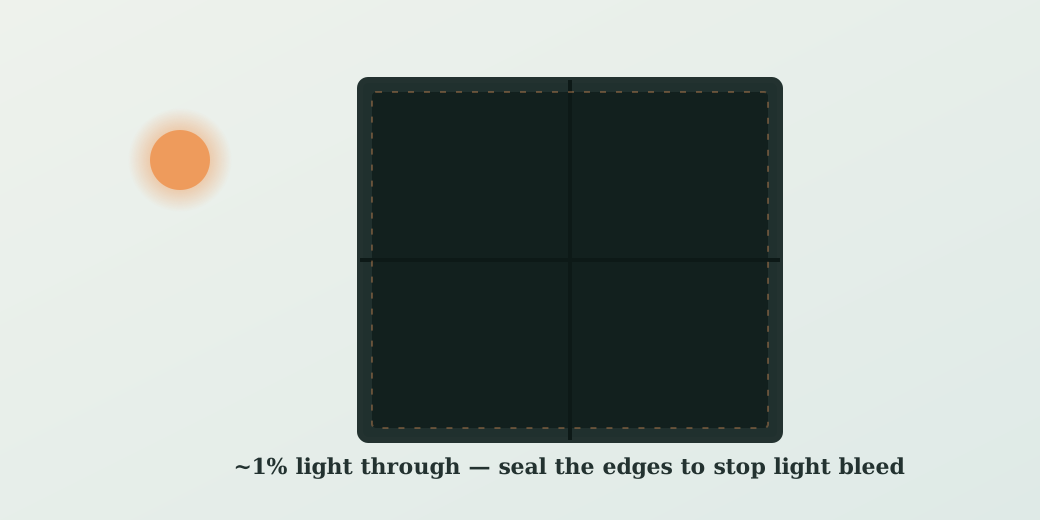
▲ Illustration — blackout film blocks almost all light through the glass; the light that remains bleeds around the edges, which a silicone bead seals.
Almost completely. Black blackout film blocks virtually all visible light through the glass (about 1% transmission), reading as total darkness — and it's fully opaque for maximum privacy. The light you'll still notice usually bleeds around the edges, not through the film, so a bead of black silicone around the perimeter gets you closest to true blackout. It applies with the wet method and is removable without marking the glass.
Guidance is compiled from manufacturer and industry sources, cited in Sources.
Does blackout film really block all the light?
Effectively yes. A black blackout film "blocks virtually 100% of visible light," with visible light transmission around 1% — described honestly as near-total light exclusion rather than a perfect absolute in every condition.[1] It's also fully opaque both ways, "completely preventing visibility through the glass from either side," which is why it doubles as a maximum-privacy film.[1]
Blackout film vs blackout curtains
| Blackout film | Blackout curtains | |
|---|---|---|
| Darkness | Darkest at the glass; edges sealed with silicone | Good, but light leaks at the sides and top |
| Opening daily | Permanent-ish; you don't open it | Easy to open and close |
| Best for | Day-sleepers, cinemas, darkrooms, nurseries | Rooms you still want to light normally |
The trade-off is simple: film gives the more complete, gap-free darkness but you give up easily letting light in; curtains are flexible day-to-day but leak around the edges. Many people film a window they rarely open and keep curtains where they still want daylight.
How to apply blackout film
Black blackout film is usually adhesive and applied to the inside of the glass with the wet method — the same technique as the bubble-free application guide: it's "installed using a simple water and mild soap solution," positioned, and squeegeed out.[1] Then run the silicone edge bead if you want true darkroom-level blackout. Some blackout films are static cling instead of adhesive, which trade a little longevity for no-residue removal.[2]
What it's good for
Blackout film suits any room that needs to go properly dark: "bedrooms, home cinemas, photography darkrooms, offices, meeting rooms and any space where complete blackout or maximum privacy is required."[1] It's a favourite of shift workers and day-sleepers, and of nurseries where an afternoon nap needs real darkness.
Removing it later
It comes off cleanly. Adhesive blackout film's "adhesive is removable with warm soapy water and will not mark or scratch the glass" — wet the surface and peel it away in strips.[1] Static-cling versions simply peel off with no residue. If you sealed the edges, you'll also scrape off the silicone bead. See our window film removal guide for the gentle method.
Privacy, darkness or heat — which film?
Enter your glass, film type and goal for a source-backed recommendation.
Affiliate disclosure: HowToApplyNow may earn a commission from qualifying purchases made through links on this page, at no additional cost to you. Products are added only after we vet the program and the terms — and only when a specific product's own instructions support their use for this task.
FAQ
Does blackout window film block 100% of light?
Almost — black blackout film blocks virtually all visible light through the glass (around 1% light transmission), which reads as total darkness in most rooms. The gap is usually light bleed around the edges, not through the film. Sealing the perimeter with a bead of black silicone gets you the closest to true blackout.
Can you see through blackout window film?
No. It's fully opaque, blocking visibility through the glass from either side, which also makes it a maximum-privacy option. Unlike frosted film you don't get a soft glow — it's dark.
Is blackout window film or blackout curtains better?
Film gives more complete darkness at the glass and doesn't sag or leave side gaps the way curtains can, so it suits day-sleepers, home cinemas and darkrooms. Curtains are easier to open and close day to day. Many people use film on a rarely-opened window and curtains where they still want to let light in.
Is blackout window film removable?
Yes. Adhesive blackout film is removable with warm soapy water and won't mark or scratch the glass; wet the surface and peel it away in strips. Some blackout films are static cling, which peel off with no residue at all.
What is blackout window film used for?
Bedrooms for shift workers and day-sleepers, nurseries, home cinemas, photography darkrooms, and offices or meeting rooms where complete darkness or maximum privacy is needed.
Sources
Research-first: a film manufacturer for the light-transmission figure, opacity, install and removal, and an industry guide for the static-cling option and blackout uses. The "near-total, not perfect" wording is kept as the maker states it.
- Purlfrost — Black blackout window film — manufacturer (~1% visible light transmission / near-total exclusion; opaque both sides; wet-method install; removable with warm soapy water; black silicone edge bead for true blackout; uses: bedrooms, cinemas, darkrooms). purlfrost.com
- CoolVu — Block-out / blackout window film guide (blackout and privacy uses; static-cling vs adhesive options). coolvu.com
The manufacturer describes the result as "near-total" rather than a literal 100%, and we keep that honesty — the residual light is edge bleed, addressed with a silicone seal. Sources last reviewed: September 2026.